
Fed Policy Impact on Indian Portfolios in 2026
Author and methodology
Radii Labs
Quantitative research and trading technology team
Radii Labs publishes research on market structure, quantitative workflows, broker connectivity, and risk-managed algorithmic execution for Indian and global markets.
Methodology: Research is reviewed for query intent, practical usefulness, and financial risk clarity before publication. Market articles separate observations from predictions and should not be read as investment advice.
This article is educational and operational research. It is not investment advice, and past or backtested performance does not guarantee future results.
For research validation
Turn this idea into testable quant research
Clarify the data, assumptions, backtest limits, and execution-readiness requirements behind a trading hypothesis.
Discuss Research ReviewHow Fed Rate Cuts Affect Emerging Economies Like India (2026 Analysis) 🇺🇸💱🇮🇳
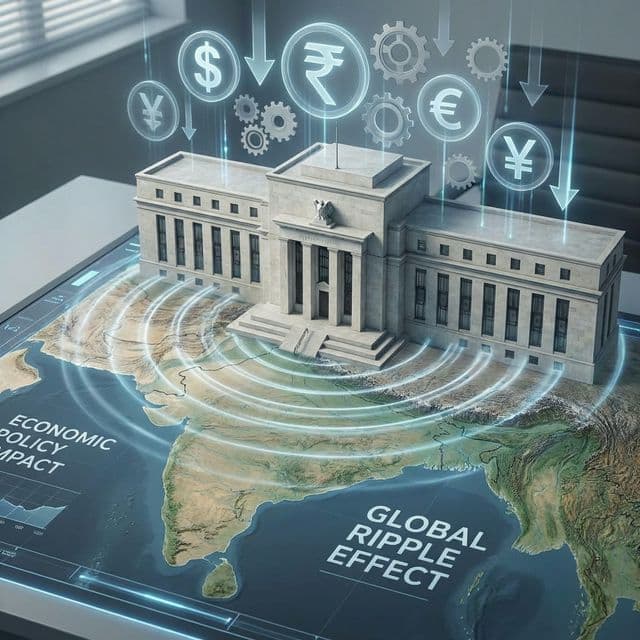
The era of "Higher for Longer" is over. As the US Federal Reserve slashes rates to projected target of 3.4% by year-end 2026, the global liquidity taps are opening again.
For emerging markets like India, this isn't just news; it's a trend reversal. At Radii Labs, we analyze how this liquidity pivot is reshaping the Nifty and the Rupee.
The 2026 Rate Landscape 📉
The spread between US and Indian interest rates determines where global capital flows.
| Metric | 2024 Peak | 2026 Status (Feb) | Impact on India |
|---|---|---|---|
| Fed Funds Rate | 5.25% - 5.50% | 3.50% - 3.75% | Lower cost of dollar debt for Indian corporates. |
| RBI Repo Rate | 6.50% | 5.25% | Cheaper home loans & acceleration in capex. |
| USD/INR | ₹83.50 | ₹90.40 | Export competitiveness improves; Tech/Pharma benefit. |
| India Forex Reserves | $640 Bn | $717 Bn | RBI has massive firepower to defend the Rupee. |
The "Carry Trade" Revival
With US yields falling, the Carry Trade is back.
- Borrow in USD: Investors borrow at 3.5%.
- Invest in INR: Investors buy Indian Government Bonds yielding 6.8%.
- Profit: The spread (plus currency hedging) generates "risk-free" alpha for FIIs.
This explains the $5 Billion FII inflow we saw in January 2026 alone.
Sectoral Impact: Who Wins? 🏆
1. IT Services & Tech
A weaker dollar usually hurts IT, but the demand revival in the US (due to cheap credit) outweighs the currency impact. US banks are spending on tech again.
2. Real Estate & Infra
RBI following the Fed's lead meaning lower EMI rates in India. We expect a 15% uptick in housing loan offtake in Q2 2026.
3. Banking
Net Interest Margins (NIMs) might compress slightly, but credit growth potential offsets it.
Conclusion: The "Goldilocks" Scenario?
India is currently in a sweet spot: Falling inflation (2.1%), Stable Currency, and High Growth (7.4% GDP). While Fed bailouts/cuts create volatility in the short term, the long-term structural story for India remains the strongest in the Emerging Market basket.
Data Sources: Federal Reserve Projections 2026, RBI Monetary Policy Report Feb 2026.
Related research
Keep exploring this topic
Algo Trading
Cross-Broker Algo Trading Platforms in India
Compare Indian algo trading platforms for broker support, no-code workflows, automation limits, and execution controls.
Global Market News
Global Events and Indian Market Impact in 2026
Understand how interest rates, geopolitical risk, and global capital flows may affect Indian market positioning in 2026.
Diversification
Portfolio Diversification Strategies for Indian Investors
Learn practical diversification frameworks for Indian investors across equities, fixed income, gold, and alternative assets.
Next workflow review
Move from reading to execution planning
Turn this idea into testable quant research
Clarify the data, assumptions, backtest limits, and execution-readiness requirements behind a trading hypothesis.