
Retail vs Prop Firm Forex Execution
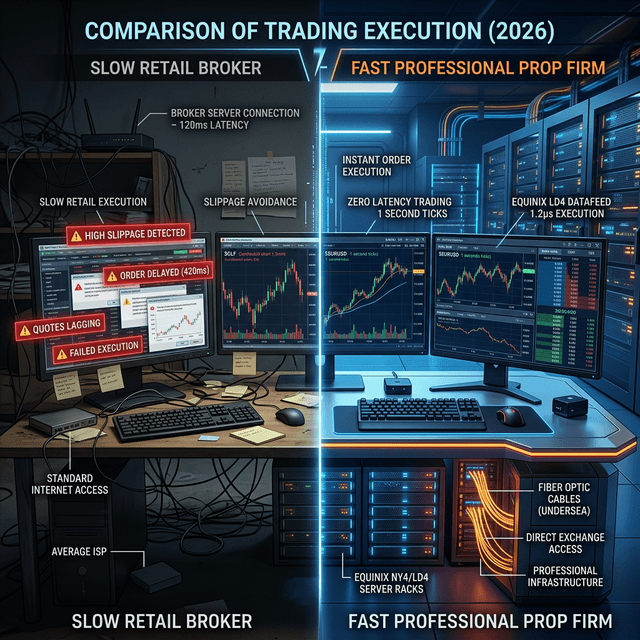
Table Of Content
Author and methodology
Radii Labs
Quantitative research and trading technology team
Radii Labs publishes research on market structure, quantitative workflows, broker connectivity, and risk-managed algorithmic execution for Indian and global markets.
Methodology: Research is reviewed for query intent, practical usefulness, and financial risk clarity before publication. Market articles separate observations from predictions and should not be read as investment advice.
This article is educational and operational research. It is not investment advice, and past or backtested performance does not guarantee future results.
For forex execution workflows
Review forex automation with risk controls
Map currency-pair monitoring, broker access, and risk gates before moving any FX workflow toward live execution.
Discuss FX WorkflowRetail vs. Prop Firm Forex Execution: The Real Difference ⚖️
In the world of Forex, execution is everything. A 2-pip slippage on a high-lot trade can be the difference between a profitable day and a break-even one. Most retail traders assume their broker provides "market" conditions, but the reality inside the order book is very different for Prop Firms versus Retail Brokers.
At Radii Labs, we’ve audited execution logs to show you exactly what happens when you click "Buy."
The Execution Gap: By The Numbers 📊
We compared the average execution quality of a top-tier retail broker against a leading institutional-grade prop firm.
| Metric | Retail Broker (Avg) | Prop Firm (Equinix NY4) |
|---|---|---|
| Execution Latency | 150ms - 300ms | < 5ms |
| Average Slippage | 0.4 - 1.2 pips | 0.0 - 0.2 pips |
| Requote Frequency | Moderate | Zero (Market Execution) |
| Liquidity Access | B-Book / Mixed | Tier-1 Prime Liquidity |
The Order Routing Path 🏎️
Why the massive difference in speed? It comes down to where the servers are located and how the order is routed.
Why Prop Firms Win on Slippage
1. Direct Fiber Cross-Connects
Leading prop firms host their trading servers in the same data centers as the liquidity providers (Equinix NY4 or LD4). This removes the "public internet" hop, reducing latency to sub-millisecond levels.
2. Market Depth (DOM)
Retail brokers often "bridge" orders, which can lead to artificial slippage during high-impact news. Prop firms typically provide access to Raw Spreads and deeper liquidity pools, ensuring large orders are filled with minimal price impact.
3. Execution Audits
Advanced prop firms now use "explainable slippage" reports. This level of transparency (often using blockchain-like audit trails) ensures that every fill is verified against the interbank rate at the exact millisecond of the trade.
Execution Speed Benchmarks (2025-2026) ⏱️
Conclusion: Which One Do You Need?
If you are a swing trader, the execution gap might be negligible. However, for Scalpers and News Traders, the retail execution model is a significant handicap.
The institutional-grade infrastructure provided by modern prop firms—and supported by the routing engines at Radii Labs—is designed to level the playing field, giving retail-funded traders the same execution edge as hedge fund desks.
Looking to optimize your execution? Check out our Routing Engine Documentation.
Related research
Keep exploring this topic
AI Trading
AI Trading Performance in India: 2026 Model Review
Review how Radii Labs evaluates AI trading models in Indian markets, including backtesting methods, risk controls, and performance assumptions.
Algo Trading
Cross-Broker Algo Trading Platforms in India
Compare Indian algo trading platforms for broker support, no-code workflows, automation limits, and execution controls.
Global Market News
Global Events and Indian Market Impact in 2026
Understand how interest rates, geopolitical risk, and global capital flows may affect Indian market positioning in 2026.
Next workflow review
Move from reading to execution planning
Review forex automation with risk controls
Map currency-pair monitoring, broker access, and risk gates before moving any FX workflow toward live execution.